



Choosing a 1.3-2.0 ATA Hyperbaric Chamber for Clinic: Engineering & Physics Guide
Why Do Leading Clinics Prioritize 1.3 to 2.0 ATA Systems?
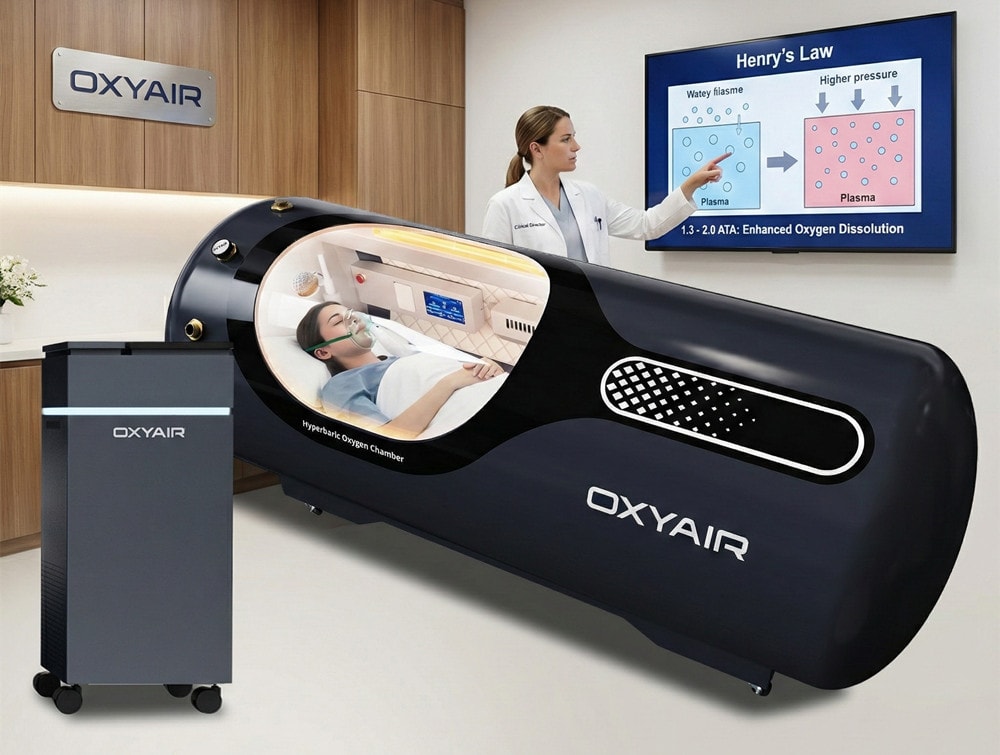
Clinics choose 1.3 to 2.0 ATA (Atmospheres Absolute) chambers because they provide the ideal balance between patient safety and physiological efficacy. While 1.3 ATA is effective for general wellness, increasing pressure to 1.5–2.0 ATA exponentially enhances oxygen dissolution in blood plasma according to Henry’s Law. This enables deep tissue recovery and mitochondrial optimization that normobaric environments simply cannot achieve.
In-Depth Technical Guide
The Physics: Henry’s Law & Plasma Saturation
At sea level (1.0 ATA), oxygen transport is limited by the saturation of hemoglobin in red blood cells. To achieve systemic optimization, clinics must bypass this biological bottleneck.
The Henry’s Law Advantage
As ambient pressure increases within a hyperbaric chamber for a clinic, oxygen is physically "pushed" into the blood plasma, lymphatic fluid, and cerebrospinal fluid. This allows oxygen to reach areas with restricted blood flow.
Mitochondrial ATP Boost
Higher oxygen concentrations at the cellular level stimulate the mitochondria to produce more ATP (Adenosine Triphosphate), the primary energy currency for cellular repair and metabolic efficiency.
ATA Selection: Matching Pressure to Purpose
In 2026, professional centers are moving away from a "one-size-fits-all" approach. Understanding the 1.3 to 2.0 ATA spectrum is vital for clinical success.
1.3ATA Hyperbaric Chamber Mild Hyperbaric (mHBOT)
Primarily used for stress reduction, cognitive clarity, and mild athletic recovery. It is the safest entry point for home users and high-traffic wellness studios.
1.5ATA Hyperbaric Chamber The "Sweet Spot" for Recovery
Widely regarded as the optimal pressure for systemic inflammation reduction and post-procedural recovery in boutique medical spas.
2.0ATA Hyperbaric Chamber Clinical-Grade Performance
Reserved for hard-shell chambers. This pressure is essential for driving maximum oxygen density into deep musculoskeletal tissues and supporting longevity-focused protocols.
Engineering for Reliability
A professional hyperbaric chamber for a clinic must withstand constant pressurization cycles. Olive Oxygen focuses on three pillars of engineering excellence:
Structural Integrity: Using aviation-grade aluminum or reinforced multi-layer polymers to ensure zero deformation at 2.0 ATA.
Redundant Safety Systems: Dual-pressure relief valves and manual emergency overrides that work independently of power sources.
Thermal Management: Advanced cooling systems to maintain a stable, comfortable temperature inside the chamber during the compression phase.