
HYPERBARIC CHAMBER PROCUREMENT GUIDE
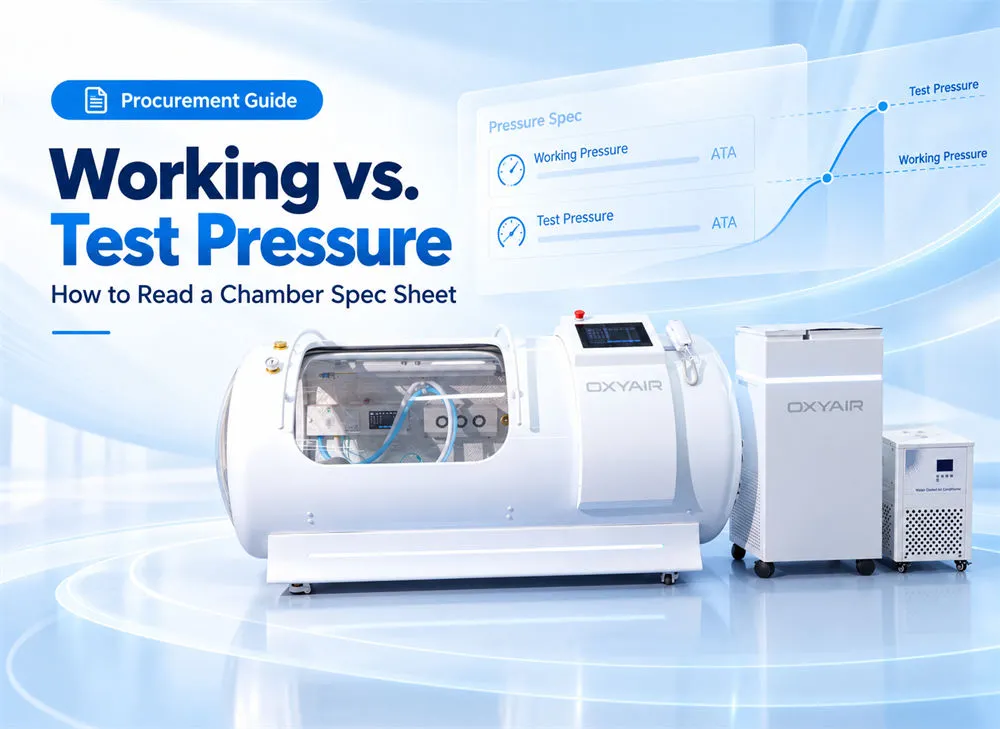
Working Pressure vs. Test Pressure: How to Read a Hyperbaric Chamber Spec Sheet
A quote lists a 2.0 ATA operating limit and a higher pressure-test value. Which number describes the chamber you can actually use—and what does the other number prove?
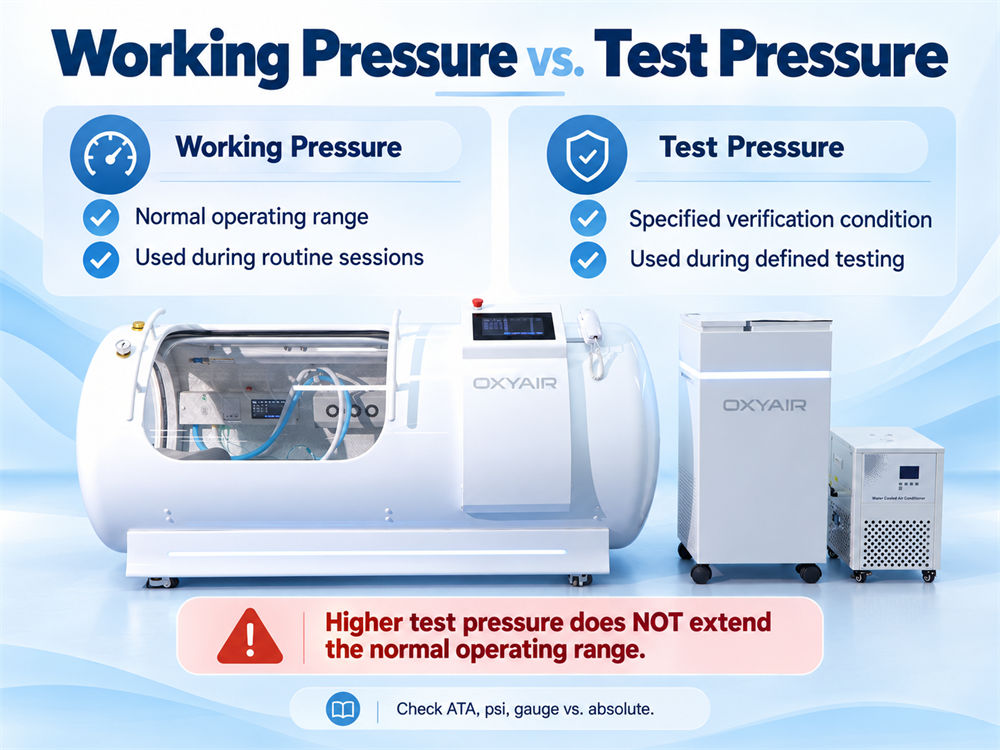
Working pressure describes normal operating conditions. Test pressure describes a specified verification condition. A higher test value does not extend the permitted operating range.
For facility buyers and distributors, a useful comparison starts with clear definitions, consistent units, and test records that match the equipment being purchased.
1. Separate the Pressure Ratings
Do not accept a single field labeled “maximum pressure” without an explanation. Ask which rating it represents.
| Term | Meaning |
|---|---|
| Operating pressure | The pressure or range used during normal operation. |
| Maximum operating pressure | The manufacturer’s specified upper limit for normal operation. |
| Design pressure | A pressure used with temperature and other conditions in engineering design. |
| MAWP | Maximum allowable working pressure established under the applicable design rules and specified conditions. |
| Test pressure | The pressure applied during a defined test. |
| Burst pressure | The pressure at which a particular specimen fails during a specified destructive test. |
Design pressure and MAWP may share a numerical value in some documents, but their meanings are different. Neither gives the operator permission to exceed the complete system’s stated operating limit.
2. Check Units and Pressure References
ATA describes absolute pressure. Values in psi, bar, kPa, or MPa also need a stated reference: gauge pressure, absolute pressure, or differential pressure.
For a chamber measured relative to outside air:
Assuming outside pressure is exactly 1 ATA, a chamber at 2.0 ATA has a pressure difference of 1 atmosphere, or about 101.3 kPa.
If an approved procedure used 1.5 times that pressure difference, the corresponding absolute pressure would be 2.5 ATA—not 3.0 ATA. This simplified example explains the math; it does not establish a required test pressure.
Compare ratings only after confirming their reference, measurement location, and any required temperature correction.
3. Identify the Test Method and Its Purpose
| Test | Primary Question |
|---|---|
| Hydrostatic test | Does the pressure boundary meet the specified liquid-pressure test requirements? |
| Pneumatic test | Does it meet the approved gas-pressure test requirements? |
| Leak test | Is leakage within the stated acceptance limit? |
| Operational test | Does the equipment perform its required functions? |
| Pressure-cycle test | How does the tested configuration perform through the specified repeated pressure cycles? |
| Burst test | What is the specimen’s failure behavior under the test conditions? |
These tests answer different questions. A leak check does not automatically establish structural strength, and one successful pressure test does not establish long-term service life.
“Proof test” also needs context. In some codes, it describes a method used to support a component’s pressure rating. Ask for the applicable definition and procedure.
4. Verify What Was Actually Tested
A material coupon, a window, a hose, and a complete chamber are different test objects. Results from one cannot automatically be assigned to another.
Were the door, windows, seals, and pressure connections included?
Were any components removed, isolated, or replaced with temporary blanks?
Was the object a prototype, a production sample, or the delivered unit?
Does the report match the current drawing and configuration?
For example, OxyHeal’s K152223 submission describes windows installed during the overall hydrostatic structural test. That detail defines part of the test scope; it is not a universal description of every manufacturer’s process.
5. Why “1.5× Tested” Is Not Enough
A multiplier is incomplete without its basis. Was it applied to MAWP, normal operating pressure, or another defined pressure? Was the test hydrostatic or pneumatic? Which standard and edition were used?
Published requirements differ by equipment, method, temperature, and regulatory context. There is no single multiplier that can be applied to every hyperbaric chamber and component.
Do not rank chambers by multiplier alone. A test-pressure ratio is not the complete engineering safety factor, and it does not create an additional operating allowance.
6. Separate Structural and System Verification
A chamber can pass a structural test while other functions still require separate verification. Review pressure measurement and control, pressurization and depressurization, alarms, relief devices, ventilation, gas delivery, electrical functions, and software as applicable.
The OxyHeal submission separates structural testing, operational checks, software validation, and factory acceptance testing. This is a useful reminder that one pressure-test result cannot cover every function.
Also distinguish the chamber’s operating limit from the relief-device setting and the pressure gauge’s full-scale range. Neither the valve setting nor the end of the dial is a normal operating target.
7. Review Evidence for the Actual Construction
For hard-shell designs, review the relevant material records, fabrication documents, weld examinations, closures, windows, and complete pressure-boundary test.
For soft-shell designs, review the load-bearing and airtight layers, seams, closure system, ports, windows, and applicable cycling or aging evidence.
Neither a material name nor a finite element analysis image replaces the required manufacturing and test records. Verification should match the construction and applicable requirements.
Continued service also depends on inspection, maintenance, environment, and component limits. Do not convert a one-time test or a cycle-test count directly into a guaranteed number of service years.
8. A Practical Pressure-Test Report Checklist
Manufacturer, model, serial or specimen number, and configuration revision.
Test purpose, scope, standard, edition, and procedure.
Pressure units, reference, medium, temperature, and duration.
Target and recorded pressures, with instrument calibration details.
Acceptance criteria, inspection results, and any repairs or retests.
Test date, report number, signatures, and witness scope.
Confirm whether the document covers design qualification, production testing, installation, or an in-service examination. Manufacturer testing, third-party witnessing, and product certification are different forms of evidence.
Missing information should remain not yet verified. Do not calculate an unsupported MAWP or burst rating from the normal operating pressure.
9. Frequently Asked Questions
Is test pressure the same as MAWP?
No. One is a test condition; the other is an established allowable rating under specified conditions.
Can a chamber operate at its test pressure?
Not unless that pressure is separately included in the manufacturer’s permitted operating range and supported configuration.
Does a burst report replace a production test record?
No. A destructive specimen test and verification of a delivered unit have different purposes.
Should buyers pressure-test a chamber themselves?
No. Any required testing should follow an approved procedure and be performed by qualified personnel with appropriate safeguards.
Request Clear Specifications and Supporting Records
Share your required operating pressure, chamber type, application, and destination with Olive Oxygen. Ask which model-specific specifications and test records are available for the proposed configuration.
Examples explain document review and do not establish requirements or certifications for other products.