


HYPERBARIC EQUIPMENT BUYING GUIDE
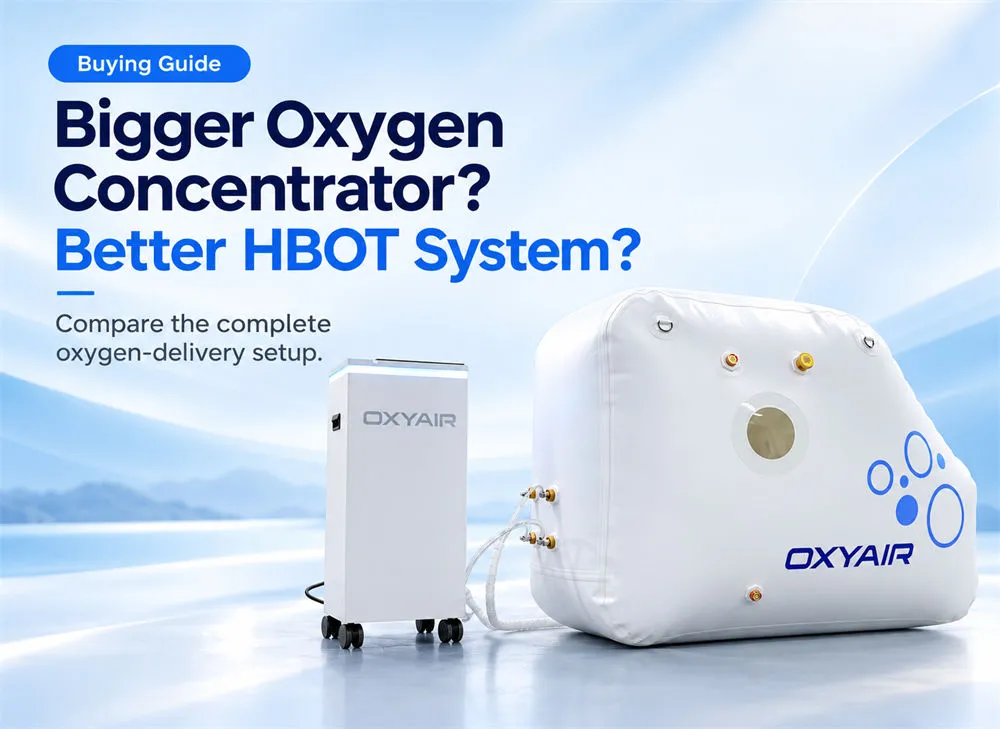
Does a Bigger Oxygen Concentrator Mean a Better Hyperbaric System?
A larger cabinet, a higher flow rating, or a second oxygen concentrator can make a package look more capable. But what does that extra equipment actually improve?
Not every increase in size or capacity makes a better system. Extra capacity matters when it meets a verified need at the chamber’s operating pressure. Commercial buyers should compare the complete oxygen-delivery setup, not just the largest number on the quote.
This guide focuses on air-pressurized chambers that supply oxygen separately through a mask or another breathing interface. Other chamber designs have different requirements.
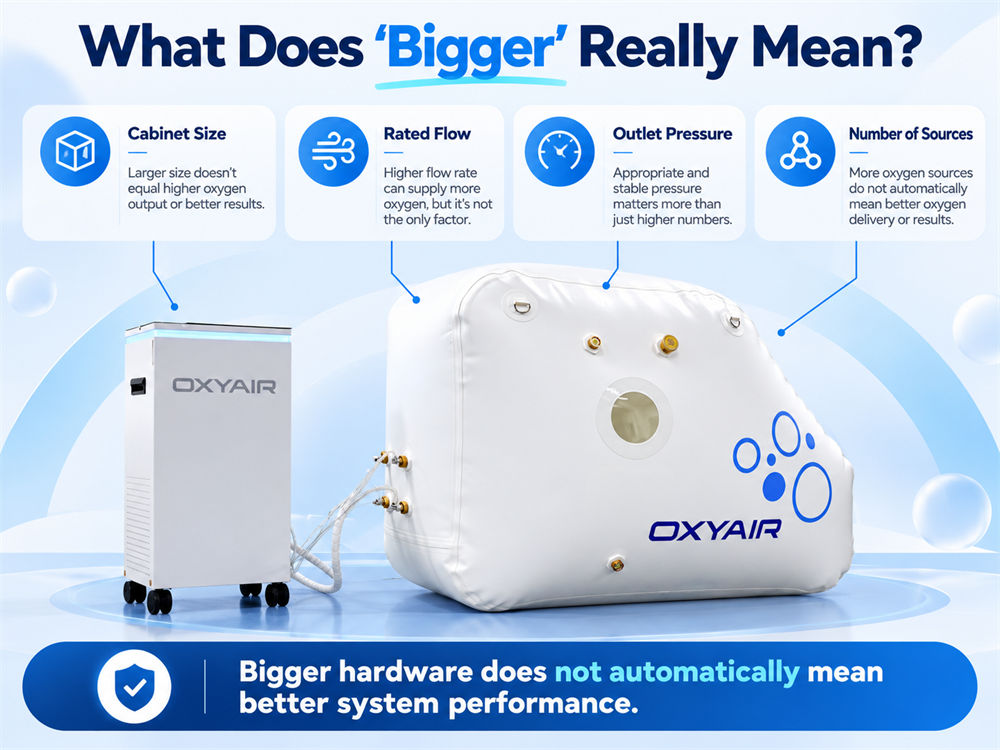
1. What Does “Bigger” Actually Mean?
Ask the supplier to separate physical size from output capacity. A large enclosure may contain an oxygen concentrator, an air compressor, cooling equipment, or several modules.
| Specification | What to Check |
|---|---|
| Cabinet size | Dimensions, installed clearance, weight, and included modules. |
| Rated flow | Gas output under stated conditions, not assumed flow inside the chamber. |
| Outlet pressure | Available pressure at the required flow. |
| Power consumption | Electrical demand, not proof of oxygen-delivery efficiency. |
| Number of sources | How capacity is distributed and what happens if one source stops. |
For example, CAIRE lists the same cabinet dimensions for its NewLife Intensity 8 and 10 models, even though their maximum rated flows differ. Cabinet size alone is a poor way to compare capacity.
2. Start with the System Requirements
Before comparing oxygen sources, define the chamber’s operating pressure, number of simultaneous users, breathing interfaces, tubing configuration, expected operating hours, and installation environment.
Also separate two functions: the air compressor pressurizes the cabin; the oxygen source supplies the breathing interface. Increasing oxygen-source capacity does not, by itself, make an air-pressurized chamber reach its target pressure faster.
3. When Higher Capacity Adds Real Value
Additional capacity may be useful when both breathing stations need supply at the same time, a particular interface requires more gas, or the existing source cannot meet the approved configuration’s requirements.
Some continuously ventilated treatment hoods have substantially different supply needs from masks. Their flow must support the specified gas circulation and carbon dioxide clearance. Requirements for one hood cannot be applied to another interface.
The extra capacity must be usable at the breathing station. A higher nameplate rating has limited value if pressure, valves, tubing, or the interface prevent the system from delivering the required supply.
If the existing configuration already meets its verified requirements, additional source capacity does not automatically increase delivered concentration or improve the user’s experience.
4. Check Pressure and Breathing-System Compatibility
Gas from an external oxygen source must overcome chamber back pressure and losses through the supply system. A maximum outlet-pressure figure does not prove the available flow at that pressure.
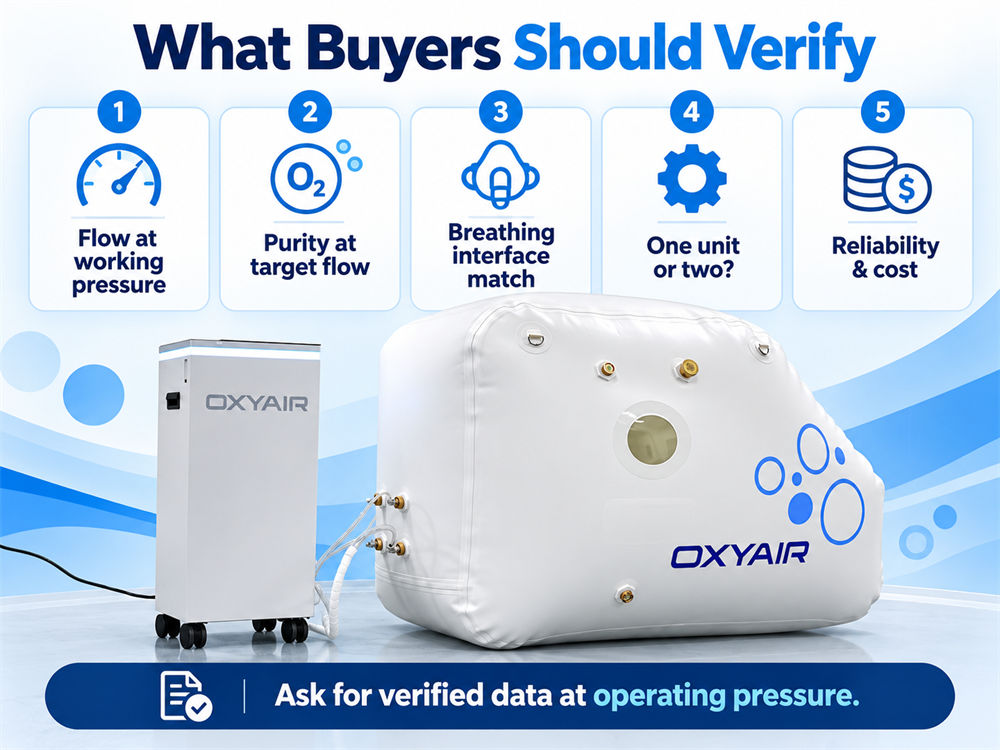
Request performance data at the intended working point: the selected chamber pressure, approved tubing, breathing interface, and number of active stations. Confirm whether flow is reported at standard conditions or as actual volume at the measurement pressure.
| Breathing System | Important Checks |
|---|---|
| Continuous-flow mask | Available flow, reservoir design, leakage, and breathing demand. |
| Demand-valve BIBS | Supply pressure, peak flow, triggering, pressure compensation, and exhalation resistance. |
| Ventilated hood | Matched supply and exhaust, oxygen concentration, and carbon dioxide clearance. |
BIBS means Built-In Breathing System. Confirm the actual design and inlet requirements. Average LPM alone cannot establish compatibility with a demand valve.
Read oxygen purity at the proposed flow setting, too. A source’s maximum flow and highest advertised purity should not be assumed to occur under the same conditions.
5. One Larger Unit or Two Separate Units?
Neither arrangement is automatically better. Compare total capacity, per-station supply, adjustment, maintenance, installation needs, and failure behavior.
Two outlets do not necessarily double capacity. The NewLife Intensity 10 dual-flow option, for example, shares a total capacity of up to 10 LPM between its outlets. That is a source specification, not confirmation of performance in a chamber.
Two concentrators also do not automatically provide backup. If both must run to meet the required load, losing one means losing needed capacity. A backup claim requires enough remaining supply for a clearly defined load, plus an approved switching and fault-response arrangement.
Test both stations together at operating chamber pressure.
Record total flow, per-station flow, and oxygen concentration.
Check whether changing one station affects the other.
Document what happens if either source stops.
6. Compare Reliability and Total Operating Cost
A larger cabinet does not prove longer service life. For commercial use, check the specified duty cycle, sustained output, cooling clearance, environmental limits, alarms, maintenance intervals, and parts availability.
Compare costs over the expected operating period:
Purchase, freight, installation, and electrical preparation.
Electricity for oxygen, air compression, and cooling.
Filters, other consumables, and scheduled service.
Repairs, international parts shipping, and downtime.
Measured average power in kW × annual operating hours = kWh.
Use model-specific data. Do not assume that every higher-capacity unit is louder or less efficient, or that a compact unit costs less to operate.
7. What an Upgrade Does Not Prove
A larger oxygen source does not automatically establish higher inhaled oxygen concentration, faster chamber pressurization, better cabin ventilation, or shorter treatment time.
Source purity, breathing-interface concentration, and chamber ambient oxygen are different measurements. A sensor at one location does not verify all three.
More capacity also does not justify claims such as “twice the results” or “half the session time.” Clinical claims require evidence for the specific treatment, system, and patient population.
Follow the chamber and oxygen-source instructions. FDA safety guidance emphasizes fire prevention, grounding, training, monitoring, cleaning, and maintenance. Extra supply capacity does not replace these measures.
8. Evidence to Request Before Approval
Exact chamber, oxygen-source, and breathing-interface models.
Approved tubing, valves, and gas-routing configuration.
Purity and available flow at the intended chamber pressure.
Total and per-station results during simultaneous use.
Flow reference conditions and measurement locations.
Test duration, environment, and electrical supply.
Instrument calibration and pass/fail criteria.
Approved replacement options and fault-response procedures.
If working-pressure flow, user-side concentration, or backup performance has not been verified, label it “not yet verified.” Do not fill the gap with estimates based on cabinet size or nameplate capacity.
9. Frequently Asked Questions
Is 20 LPM always better than 10 LPM?
No. The benefit depends on verified supply requirements, pressure, interface compatibility, and simultaneous demand.
Can two concentrators serve as a backup system?
Possibly, but only if remaining capacity and the approved switching arrangement support the defined essential load.
Can we upgrade the oxygen source later?
Ask the chamber manufacturer to approve the exact replacement and configuration. Matching a flow label is not enough.
Does higher capacity improve treatment results?
Source capacity alone cannot support that claim. Equipment performance and clinical outcomes require different evidence.
Request a Matched System Configuration
Share your target pressure, user count, interface requirements, operating schedule, and destination with Olive Oxygen. Ask for the specifications and available verification data behind the proposed configuration.
Manufacturer examples explain specifications; they are not chamber compatibility recommendations. This guide does not prescribe treatment settings.