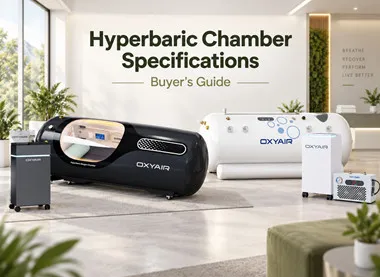

How to Compare Hyperbaric Chamber Specifications
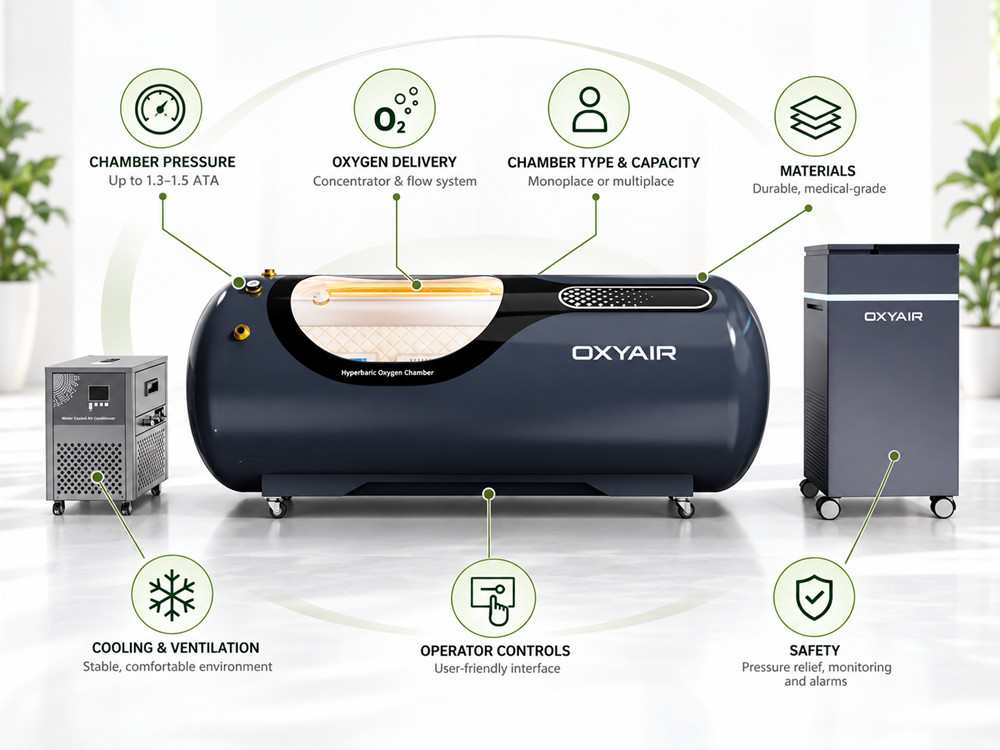
ATA, oxygen output, dimensions, noise, and materials only become useful when the supplier explains the test conditions and complete system configuration.
By: Olive Oxygen Editorial Team | Reviewed by: OXYAIR Technical Team | Updated: September 16, 2026
1. ATA: Verify the Working Pressure
ATA means atmospheres absolute. Normal pressure near sea level is about 1.0 ATA. Gauge pressure can be estimated as (ATA − 1) × 14.7 psig, so 1.5 ATA is about 7.4 psig. ATA does not state oxygen purity or delivery.
Ask the supplier to separate these values
Working range and maximum operating pressure
Design and test pressure
Control accuracy and pressure-change rates
Relief devices, emergency procedures, and cycle records
Higher ATA is not automatically better. The appropriate range depends on the intended setting, model, protocol, and local requirements.
2. Oxygen Delivery: Trace the Gas Path
Pressure and oxygen delivery are separate. In an air-pressurized system, a compressor raises chamber pressure while oxygen reaches the user through a mask or Built-In Breathing System (BIBS). The chamber itself is not filled with oxygen.
Outlet purity is not a guaranteed inhaled concentration. Flow, back pressure, mask fit, breathing demand, and exhalation design can affect delivery.
Information to request
Source and rated purity at the stated flow
Flow and pressure per station
Performance at maximum chamber pressure
Number of masks used simultaneously
Exhaled-gas route, monitoring, and backup
3. Size: Plan Beyond the Chamber
Chamber dimensions are not the required room size. Allow for oxygen equipment, a compressor, climate control, hoses, door movement, and service access.
| Dimension | Why It Matters |
|---|---|
| Internal usable size | Position, comfort, and capacity |
| External size | Room planning |
| Entry opening | User access |
| Installed footprint | Modules, operation, and service |
| Packed size and weight | Freight, access, and floor loading |
Request a model-specific installation drawing. Confirm power, ventilation, delivery access, turning clearance, and hose limits.
4. Noise: Compare Like With Like
System sound can come from compressors, concentrators, fans, valves, airflow, ventilation, and pressure release. A value such as “under 60 dB” is not fully comparable unless the test conditions are stated.
Ask whether the reading is dB(A), where and how far away it was measured, the operating phase, and which modules were running. Research on 41 multiplace chambers found that sound varied by phase and ventilation status. Those figures do not apply directly to other chamber types, but they show why test conditions matter.
5. Materials: Ask for Evidence
Hard chambers may use pressure-vessel steel, aluminum alloy, acrylic viewing sections, coatings, and engineered seals. Flexible chambers may use reinforced substrates with gas-barrier coatings, flexible windows, seams, and zipper assemblies. Construction varies by model, so a broad label such as “medical grade” is not enough.
Documentation to review
Material grade, thickness, and traceability
Certificates and test reports
Inspection and pressure-test records
Rated cycle life
Viewport, cleaning, and replacement requirements
ISO 13485 covers a medical-device quality management system; it does not by itself prove a model’s pressure rating, material grade, or market authorization.
6. Commercial RFQ Checklist
Country, setting, capacity, and pressure range
Room, doorway, elevator, and loading limits
Expected daily cycles
Oxygen source and breathing stations
Required documents, training, warranty, and service
For the U.S. medical-device market, verify the exact model. FDA establishment registration is not model-level 510(k) clearance.
7. Frequently Asked Questions
Is maximum ATA the normal operating pressure?
No. Ask for the working range and separate operating, design, and test pressure.
Does 93% outlet purity mean the user inhales exactly 93%?
No. Mask delivery also depends on flow, pressure, fit, and breathing demand.
Can supplier noise ratings be compared directly?
Only under reasonably equivalent test conditions.
What should be checked before installation?
Review footprint, delivery route, floor loading, power, ventilation, and service access.
Request a Model-Specific Configuration
Share your target pressure, capacity, facility dimensions, and market requirements with Olive Oxygen.
Request Technical InformationReferences
U.S. FDA: Safe Use of HBOT Devices · 21 CFR 868.5470 · NOAA: Understanding Pressure · In-Chamber Sound-Level Study · ISO 13485